The first methane footprint report for the fashion industry, jointly published in 2025 by Collective Fashion Justice and researchers from Cornell University and New York University
"We cannot fix what cannot be fixed. And we cannot understand what we do not understand."
— Collective Fashion Justice, Now or Never, 2025
The fashion industry has long framed climate discussions around carbon (CO₂). However, there is a figure that has never been publicly measured. It is the methane (CH₄) footprint.
The report presents the fashion industry's methane footprint figures for the first time. Within it, we found data that demonstrates why BROWNSKIN is undertaking this work now.
1. The Hidden Climate Culprit of the Fashion Industry — Methane
When discussing the fashion industry's annual greenhouse gas emissions, the industry mainly uses CO₂-equivalent values (CO₂e). However, this metric converts methane, a gas with entirely different properties, into CO₂ terms and thereby obscures it. Unless methane is examined separately, we only understand half of the climate crisis.
The following is a summary based on the report's findings.

🌍8.3 million tonnes of CH₄ per year is the amount of methane the fashion industry emits annually.
Unlike CO₂, which remains in the atmosphere for hundreds of years, methane breaks down in about 12 years. Although it exists for a short time, during those 12 years its warming effect is 86 times that of CO₂. In other words, reducing methane now can slow the rise in global temperatures within our lifetimes. If carbon reduction is an investment for generations hundreds of years from now, methane reduction can serve as an emergency brake with effects that show up immediately.
2. Why Leather Accounts for More Than Half of the Methane Footprint
The most noteworthy data in the report is the breakdown of methane emissions by material.
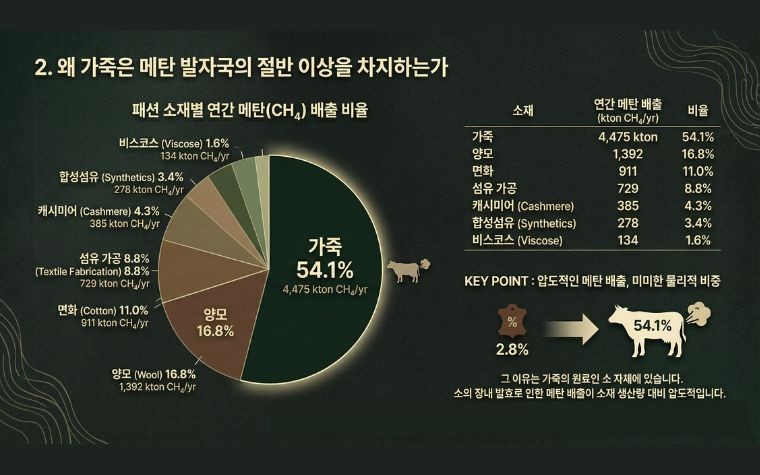
Leather alone accounts for 54.1%. However, in terms of total fashion material production, leather's physical share is only 2.8%.
It uses relatively little material, yet it produces methane on a massive scale.
The reason lies in the cow itself, the source of leather.
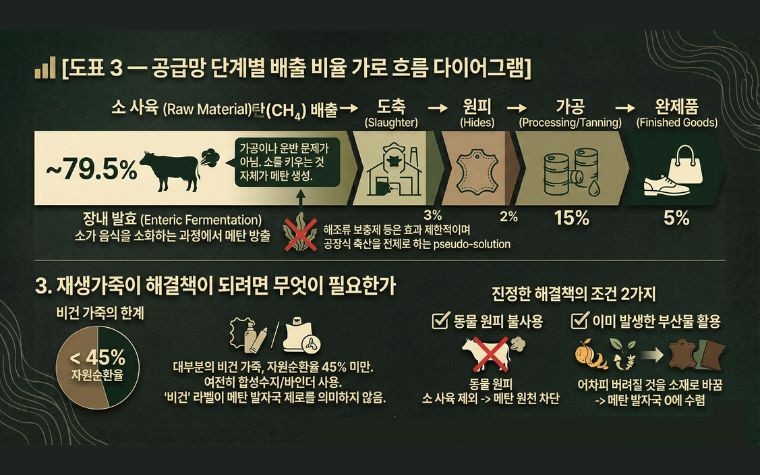
Enteric Fermentation — the biological process by which cows release methane through belching and flatulence as they digest food. This accounts for nearly all of leather's methane footprint. It is not a problem of processing or transport. Raising cattle itself generates methane.
Therefore, regardless of the tanning method or the certifications obtained, this methane footprint is unavoidable as long as animal hides are used as the raw material. Technical solutions such as seaweed feed supplements have been proposed, but the report clearly cautions against them, describing them as "pseudo-solutions" with limited effectiveness that presuppose factory farming.
3. What Recycled Leather Needs to Be a Real Solution
At this point, an important question arises: "Is recycled leather enough?"
It is not. Most vegan and plant-based leathers on the market have a resource circulation rate of less than 45%. A significant portion of their raw materials is still made up of synthetic resins and chemical binders. More importantly, the "vegan" label does not mean zero methane footprint. Raw material sourcing, processing energy, and binder materials are all linked to carbon and methane emissions.
Two conditions must be met for a true solution.
First, do not use animal hides as the raw material. Without raising cattle, enteric fermentation methane is eliminated at the source.
Second, use by-products that have already been generated. If materials that would otherwise be discarded are turned into new material without new cultivation or livestock rearing, the methane footprint of that raw material effectively approaches zero.
4. BROWNSKIN's Approach: 88% Resource Circulation + Zero Animal Hides
BROWNSKIN produces recycled leather in a way that satisfies both of these conditions at the same time.
Our raw materials include coffee grounds, cocoa husks, citrus peel, brewers' spent grain, apple peel, and hemp, all by-products generated during food processing. These are not consumed raw materials — they are materials that would otherwise be discarded. Therefore, using these materials does not generate any additional greenhouse gas emissions.
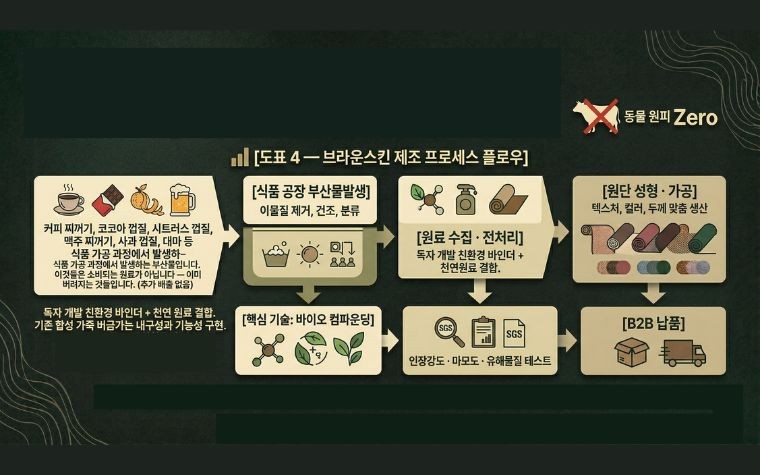
The core technology is Bio Compounding. By combining the natural fibers and organic components of food by-products with our proprietary eco-friendly binder, we achieve durability and functionality comparable to conventional synthetic leather. We minimize harmful chemicals such as PVC and DMF, and convert more than 88% of input raw materials into material.

5. What the Numbers Prove
The report specifies that the fashion industry must reduce methane emissions by 30% by 2030 compared to 2020. This is the minimum requirement for achieving the 1.5°C target set by the IPCC. The report also firmly states that this is "a target that cannot be achieved without reducing reliance on animal-based materials."
BROWNSKIN's recycled leather is a practical means of achieving precisely this reduction. By replacing animal hides, it eliminates at the source the methane generated at the materials stage. By utilizing more than 95% of food by-products that would otherwise be discarded, it supplies high-quality material without additional resource consumption.
BROWNSKIN recycled leather is not an emotional choice. It is the result of responding with technology to the direction the data points.
For material sample requests, B2B supply inquiries, and joint R&D partnerships, please contact us below.
📩 Contact Us → brownskin.kr/contact
This article references the research data of Collective Fashion Justice's Now or Never: A First Methane Footprint for the Fashion Industry (2025) and Roncevich, Hakansson et al., Fashion's Methane Footprint: Estimated Emissions Intensity and Importance Across the Global Industry (2025).