Hello,
This is Woody from the AX Transformation Team.
As mentioned in our earlier apple pomace material flow analysis, our team is establishing a database of by-products as part of developing ByOrbit. In this process, we are focused on collecting and re-establishing data and building our own in-house database. This time, we would like to introduce the agricultural by-product analysis agent we use internally.
Why Do We Need Analysis of By-Product Raw Material Conversion?
Much data has already been accumulated on raw materials in their original form. However, for by-products, that data is very difficult to find. Is it because by-products have no potential as raw materials? Our team's research showed the opposite. Many products we use, knowingly or unknowingly, actually originated from by-products. 'Naphtha,' which has recently surfaced as a petroleum issue, is also a polymeric carbon compound produced during petroleum refining. And 'whey,' which many people consume in protein shakes, is the liquid left after separating the curd (milk solids) during cheesemaking. Fifty years ago, whey left over from cheese production was simply discarded, but today it is used and contributes to reducing food waste. There are many other raw materials as well.
That is why we are building a database of ingredient components as by-products are converted into raw materials. Even if it does not necessarily lead to a material, we believe the future we should pursue is one in which agri-food by-products that would otherwise be discarded are not only reduced, but also gain value as raw materials that our lives need.
However, collecting and analyzing data on by-product raw material conversion is not an easy task. So we are working to build an AI analysis agent that can be standardized by gathering this data from the ground up. Because we still lack sufficient data, we cannot yet be certain of its accuracy. However, if we keep building on it, we expect it to save an enormous amount of time in the future.
Raw Material Data Built on the National Standard Food Composition Database
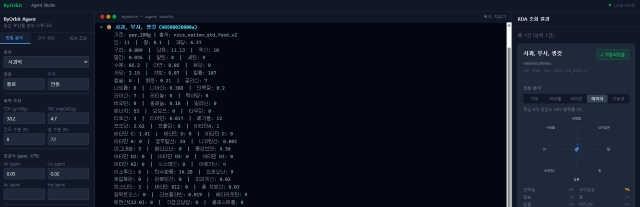
Data on raw materials is already well organized in the National Standard Food Composition Database. Collecting raw material data was not difficult. We built a database of basic composition for each raw material and set it up to enable composition analysis based on our own established analytical criteria. The data gathered through this process has been structured to support both preliminary diagnosis and detailed analysis according to our analytical standards. Narrowing the gap between this and actual composition data remains an ongoing mission. Nevertheless, our baseline analysis has reached a reasonable level of reliability.
Validation Stage
We are at the stage of collecting and validating data on the condition of by-products and data after pretreatment, based on our basic raw material data. As a starting point, we are first validating with data the materials and products we have previously developed. Once this project is on track, our goal is to be able to predict the raw material value of by-products even through preliminary diagnosis. We plan to define demand, evaluate suitability, and provide reports.
In this process, we are assessing suitability against product goals, required functions, and permissible conditions, and preparing sample work on the Spec Sheet, COA structure, and processes, along with internal bench testing. We are also preparing to enable PoC and pilot production for consistency verification.
Another important step is that regulatory review runs alongside this validation process. We are mapping both domestic and international routes for this, and if the value as a high value-added raw material is confirmed, we will explore together how to resolve these requirements quickly.
This project is also a very important validation project for us internally. We continue to communicate with our research institute and keep refining its completeness. Going forward, we aim to establish the standards needed for data-driven raw material development. Since 2025, we have been conducting the ByOrbit project in industry-academia cooperation with Sungkyunkwan University, and this year we have begun building the by-product database in earnest.
Thank you.