Building the ByOrbit Raw Material Nutrition MCP
When working with food ingredients, one question always comes up first.
“What nutrients does this raw material contain?”
“Can we instantly compare the nutritional content of apples and citrus?”
“Can we explain nutrient changes after pressing, drying, and powdering with data?”
While preparing the ByOrbit project, we concluded that a system that only collects, pre-processes, and distributes agricultural by-products is not enough.
The core of raw material conversion is, after all, data.
Even the same apple becomes a completely different raw material as fresh fruit, pressed juice, juice, jam, freeze-dried product, or apple pomace.
Even the same citrus fruit differs in water, sugar, vitamin C, and dietary fiber content across Satsuma mandarin, Hallabong, Cheonhyehyang, and Redhyang.
To let AI directly query and compare nutritional data for raw materials and processed foods, ByOrbit built the Raw Material Nutrition MCP.
What Is MCP?
MCP is short for Model Context Protocol.
Put simply, it is a connection standard that lets AI models link to external databases and services and directly retrieve the information they need.
Previously, users had to look up data themselves, open tables, check nutrient names, and then paste them into AI.
With MCP connected, however, AI can understand the question and call the necessary tools to fetch the data itself.
For example, a user asks:
Tell me the nutritional content of apples.
Rather than answering through simple search and inference, AI
searches apple data in the actual database via the ByOrbit Raw Material Nutrition MCP and responds based on those results.
Why Is a Raw Material Nutrition MCP Needed?
Food ingredient data differs from general textual knowledge.
Exact values, units, reference amounts, and sources are critical.
For example, even describing apples requires all of the following information.
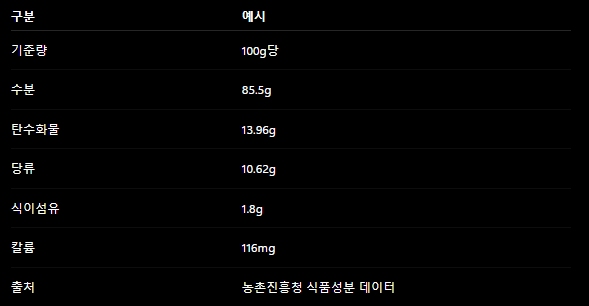
Data like this matters far more than statements such as “apples are good for your health.”
Especially in areas such as raw material conversion, product development, research projects, ESG reports, CoA, and DPP, quantitative data is the baseline language.
The ByOrbit Raw Material Nutrition MCP was built to solve this problem.
Current Data Structure
The ByOrbit Raw Material Nutrition MCP currently connects the following data.
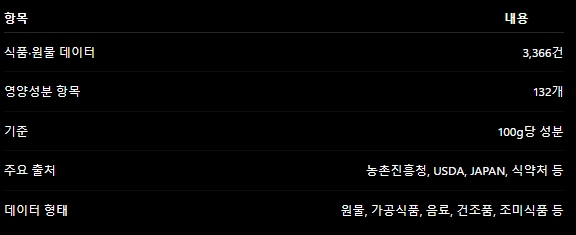
The nutrient items currently included go beyond basic energy, water, protein, fat, and carbohydrates to also cover detailed items such as the following:
- Sugars
- Fructose
- Glucose
- Sucrose
- Total dietary fiber
- Calcium
- Potassium
- Magnesium
- Iron
- Zinc
- Vitamins
In other words, it is less a simple calorie lookup database and more a foundational nutrient layer for raw material analysis and comparison.
Key Features of the ByOrbit Raw Material Nutrition MCP
The MCP is currently built around four main functions.
1. Raw Material Search
When a user enters a food name such as “apple,” “citrus,” or “almond,” the system searches related food data.
For example, searching for “apple” returns data such as the following.
Search result example: Apple, raw; Pressed apple; Apple juice; Apple drink; Apple jam; Canned apple; Freeze-dried apple; Apple pie; Apple vinegar
This feature goes beyond finding a single raw material; it helps confirm which processed food forms the same ingredient exists in.
2. Detailed Nutrient Lookup
Selecting a specific food shows its detailed nutrient content per 100 g.
For example, for “Apple, raw,” the following basic nutrients can be retrieved:
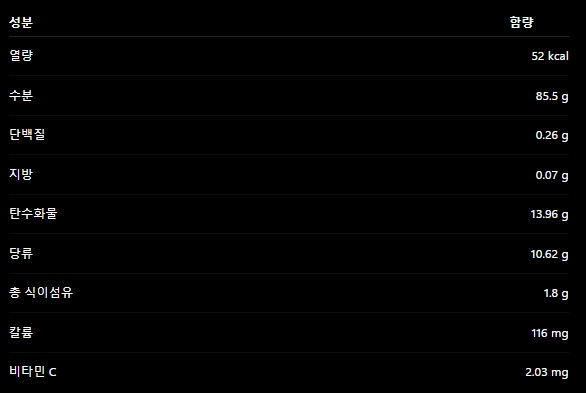
This data can be used directly in ingredient descriptions, product planning, presentation materials, and research project documents.
3. Nutrient Comparison Across Raw Materials
One of the key functions of the Raw Material Nutrition MCP is comparison.
For example, comparing apples and citrus allows answers to questions like these:
Between apples and Jeju tangerines, which raw material has higher vitamin C?
Between apples and almonds, which ingredient has higher dietary fiber?
How does the nutrient profile of apples change before and after drying?
In fact, comparing raw apples with freeze-dried apples shows that dietary fiber, sugars, potassium, and others become concentrated as moisture is removed.
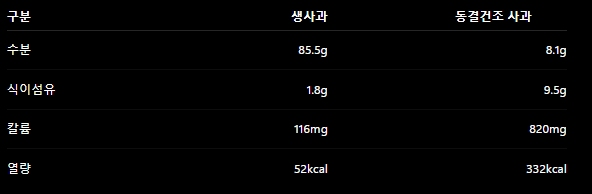
Comparisons like this are essential when designing raw material pre-processing and processing methods.
4. Database Statistics
The MCP also lets users check the overall data scale and nutrient item coverage.
As of now, 3,366 food and raw material records and 132 nutrient items are connected.
This forms a foundational data asset that can connect with ByOrbit’s raw material conversion system, CoA Agent, DPP, and ESG reporting in the future.
Practical Usage Examples
Example 1: Apple Nutrient Lookup
User question:
Tell me the nutritional content of apples.
Through the MCP, AI searches apple data and retrieves the nutrient profile for “Apple, raw.”
Sample response:
Per 100 g of raw apple: energy is 52 kcal, water 85.5 g, carbohydrates 13.96 g, sugars 10.62 g, and dietary fiber 1.8 g. Potassium is 116 mg and vitamin C is 2.03 mg.
This answer is not generic AI inference; it is generated from the connected nutrient database.
Example 2: Calculating Daily Almond Intake
User question:
Tell me the nutritional content of almonds and the recommended daily intake.
The MCP retrieves nutrient data per 100 g of roasted almonds.
Based on that, AI converts this to a daily intake of 20–25 g and explains it.
A daily amount of 20–25 g, roughly 20–25 almonds, is appropriate; at this amount, intake is about 120–150 kcal.
In this way, the MCP provides the source data, while AI handles interpretation and conversion to match the context of the user’s question.
Current Limitations of the MCP
The Raw Material Nutrition MCP is currently built around a basic nutrition database.
As a result, not every functional ingredient is directly included.
For example, the following items are either not directly included in the current base database or require separate expansion with experimental or literature databases.
For example, for the question “How much polyphenol is in apples?” the MCP’s basic nutrition database alone cannot provide a confirmed value.
In such cases, AI must distinguish between basic nutrient data, literature scope, and experimental criteria when answering.
These limitations in fact point to the next stage of expansion.
Future Expansion Directions
The ByOrbit Raw Material Nutrition MCP will not stop at being a simple nutrient lookup tool.
Going forward, it could connect to the following data layers:
1. Expanding the Functional Ingredient Database
Separate databases can also be built for major agricultural by-products such as apple, citrus, pear, napa cabbage, and radish.
As this data is continuously connected, AI can provide explanations from a functional ingredient perspective, not just basic nutrition.
2. Integrating Process Data
Agricultural by-products have high moisture content and spoil quickly, so process conditions across the entire chain are critical.
In the future, process data could be linked to the MCP.
How do moisture and dietary fiber change when apple pomace is dried with a heat pump?
How much vitamin C is lost when citrus pomace is freeze-dried?
How do organic acid levels change when napa cabbage by-products are fermented?
3. Connecting to the CoA Agent
In raw material trading, what matters is not only the nutrition label but the Certificate of Analysis (CoA).
In the future, the ByOrbit Raw Material Nutrition MCP could play a role by connecting with the CoA Agent.
In other words, it could evolve from “an MCP that reports nutrients” into “an MCP that evaluates raw material quality.”
4. Linking DPP and Raw Material Traceability
ByOrbit aims to build a system that converts agricultural by-products into raw materials.
Accordingly, raw material nutrient data can also be linked to the DPP, or Digital Product Passport.
Once this structure is in place, it can go beyond simple nutrient lookup to connect the origin, process, quality, and potential uses of each raw material.
The Significance of the Raw Material Nutrition MCP for ByOrbit
ByOrbit aims for a system that turns agricultural by-products into raw materials rather than treating them as simple waste.
The key here is not only collection and logistics.
What truly matters is whether we can answer the following questions.
What nutrients does this by-product contain?
What pre-processing turns it into which raw material?
Which product categories can it be used in?
Does it meet quality standards?
Can it be turned into standardized data suitable for trade?
The Raw Material Nutrition MCP is the first data layer for answering these questions.
Once AI can directly retrieve, compare, and interpret raw material nutrients, the scope of application for the raw material conversion system expands significantly.
Conclusion
The ByOrbit Raw Material Nutrition MCP is a nutrient lookup and comparison tool that enables AI to directly use agri-food ingredient data.
Currently, based on 3,366 food and raw material records and 132 nutrient items, it provides raw material search, detailed nutrient lookup, nutrient comparison, and database statistics.
Going forward, we plan to connect it with functional ingredients, pre-processing processes, CoA, DPP, and ESG reports, expanding it into core data infrastructure for agricultural by-product raw material conversion.
In short, the role of this MCP is simple.
Converting the nutrients of raw materials into data AI can understand,
and connecting that data to raw material conversion, productization, quality control, and trading systems.
The ByOrbit Raw Material Nutrition MCP is the first technical foundation for transforming agricultural by-products from “waste to be disposed of” into
“raw materials that can be explained through data.”