The Food Technology Division of the National Institute of Crop Science under the Rural Development Administration (RDA) held the “3rd Food Tech Upcycling Consultative Body Meeting” on March 25 and shared plans to build an integrated information system for agricultural by-products. We also attended, since we are participating in the R&D project. Our ByOrbit is likewise in the process of building a system to digitize agricultural by-products and turn them into industrial resources.
The full text of the press release follows.
Press Release
A data-driven infrastructure to systematically manage and utilize the 9.34 million tons of agricultural by-products generated annually is now moving forward in earnest.
As the RDA launches the construction of an integrated information platform that connects the entire lifecycle of agricultural by-products, expectations are growing for the expansion of the upcycling industry and the shift toward resource-circulating agriculture.
At the “3rd Food Tech Upcycling Consultative Body Meeting” held on the 25th at the National Institute of Crop Science under the RDA, the “Integrated Information System Construction Plan for Agricultural By-Products,” jointly pursued by CamiNet and Chung-Ang University, was unveiled.
This research focuses on building a data foundation so that agricultural by-products can be systematically managed and utilized for industrial purposes.
Agriculture Also Faces Demands to Shift to Resource-Circulation Systems Amid Expanding ESG
Researcher Lee Hyun-ju of CamiNet, who explained the background and technical direction of the project, said, “As ESG management spreads and carbon neutrality policies strengthen, the agricultural sector is also being asked to shift toward resource-circulation-based systems.”
Agriculture accounts for roughly 20% of global greenhouse gas emissions, and the incineration or abandonment of agricultural by-products is identified as a major factor leading to methane and nitrous oxide emissions.
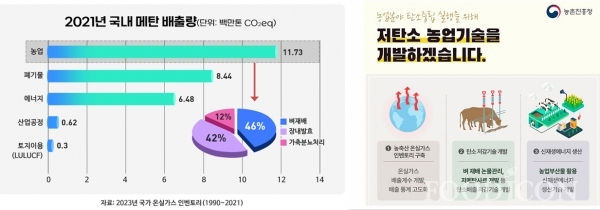
In Korea, agricultural by-product generation is estimated to reach 9.34 million tons per year, and a large share of it is incinerated or left unused. The socioeconomic cost of this process is estimated at roughly 20 trillion won.
Researcher Lee emphasized, “It is time to move away from disposal-centered treatment and toward a resource-circulating structure.”
Data Is the Key Barrier Holding Back the Upcycling Industry
The expansion of agricultural by-product utilization is progressing slowly because the underlying data foundation is not in place. Currently, related information is dispersed across institutions and not standardized, which limits interconnection and use.
In particular, concerns were raised that the lack of systematic data on quality and safety places a burden on companies using these materials as raw inputs. In addition, a structure in which utilization value is rated low relative to collection costs was cited as another factor constraining industrial expansion.
Researcher Lee explained, “To activate upcycling, data standardization and the establishment of an integrated management system must come first.”
LanguaL-Based Standardization: Establishing an Information System for Agricultural By-Products
The core of this project is data standardization using LanguaL, an international food classification system. LanguaL structures data based on 13 categories, including food source, processing method, physical state, packaging, and storage, which ensures international compatibility.
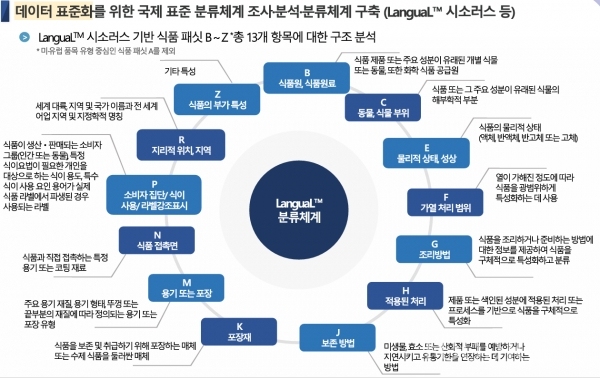
Researcher Lee explained, “Even by-products such as soy pulp (okara) can be managed in detail by raw material, part, processing method, condition, and intended use,” adding, “This allows them to be converted into data that can be used by industry.”
This system is expected to serve as a foundation that enables linkage among the food, bio, and materials industries.
Building an Integrated DB-Based Platform and Expanding into AI Services
Starting with the construction of an integrated agricultural by-product database, the research team plans to develop it into a platform centered on industrial use.
The platform will integrate diverse information, including generation volume, composition, functionality, quality and safety, and utilization potential. Based on this, it will provide demand-tailored information, utilization guides, and supply chain linkage features.
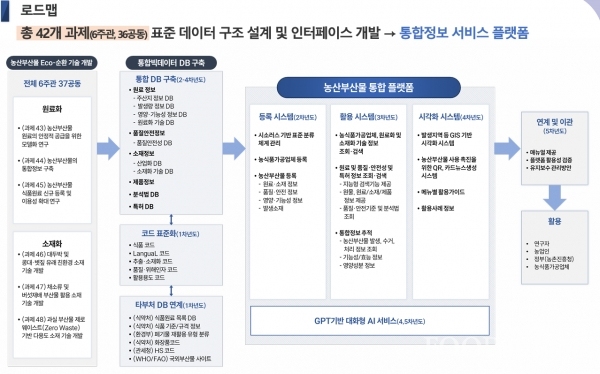
In the future, the service will be enhanced by applying a GPT-based interface that provides information in response to user queries.
Researcher Lee emphasized, “The key is to make the data actually usable in industrial settings.”
A Growing Upcycling Market, Aligned with Policy and Industry
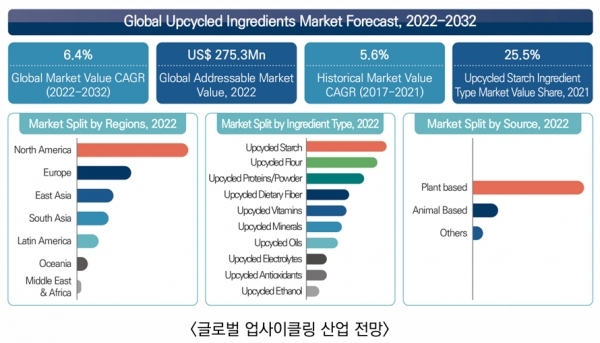
The food upcycling market is projected to grow from $55.1 billion in 2023 to $85.9 billion in 2033.
In Korea, the development of related technologies and products is also expanding, and the government has designated the field as a core area of food tech and is strengthening support for it.
This project is expected to play a role in building the industrial foundation in line with these market trends and policy directions.
Targeting an AI-Based Platform by 2029 to Drive Structural Change in Agriculture
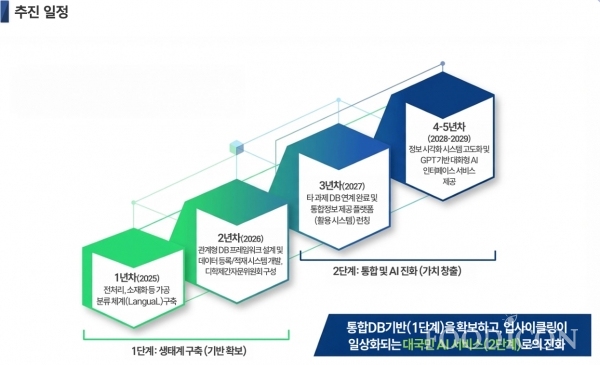
The project will proceed in phases: establishing a data standard system in 2025, developing an integrated platform in 2027, and implementing AI-based services by 2029.
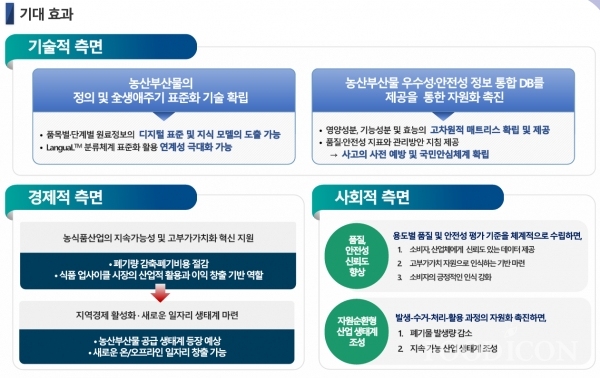
Once the platform is complete, various effects are expected, including reduced disposal costs, the development of high-value-added materials, and expanded linkages across industries.
If the utilization of agricultural by-products extends beyond food into bio-materials, pharmaceuticals, and energy, the industrial role of agriculture is expected to expand even further.