"We plan to launch our diary at the end of this year."
Once it was published in the interview article, it became a public promise. The diary had to be released before the year-end. Material development, partner coordination, product design, and crowdfunding preparation all had to take place within the same year.
[Read the full interview article ↗]
Why the first product is a diary
When choosing a product, there was one question: which form factor would best let people experience the functions of our coffee-grounds recycled leather material?
A diary is an object people handle every day. It sits on a desk, in a bag, in the hand. The deodorizing function covered in EP.04 and the subtle aroma of coffee grounds are not something you sense from a distance. They are felt up close and through frequent contact. A diary that is touched several times a day was well suited to convey these two qualities.
Another reason was that its durability requirements are relatively lower. Shoes must withstand extreme conditions such as long hours of wear, repeated friction, and sweat. A diary cover is used in a gentler environment. In the early stage of material development, it made sense to start with the least demanding durability conditions: prove the function, accumulate data, and then extend to harsher conditions.
The year-end timing also worked in our favor. Demand for diaries concentrates at the end of each year. We could keep the interview commitment while naturally securing a market launch window.
The work of designing the product
Developing a material and making a product are different tasks. Material development is the challenge of optimizing physical properties, while product development is the challenge of completing an object that people use. The fastest way to verify how the material's characteristics perform in real-world use was to make a product.
Viewing a diary cover as a sheet of material is different from viewing it as part of an object you will touch every day for a year. Size, thickness, the feel when opened, and harmony with the inner pages were parts we had not considered important during material development. Even after the cover material was decided, there were still decisions to make before the product could be finished. Material design and product design had to proceed almost simultaneously. During prototyping, the material specifications were revised again. If the cover lacks sufficient flexibility, it resists when the diary is opened; if it is too flexible, it cannot hold its shape. The back-and-forth between the material development team and product design repeated.
Prototypes and mass production are different
Once the crowdfunding campaign reached its goal, we moved into mass production preparation. It was different from making prototypes. A prototype is a process of meeting conditions; mass production is a process of repeating those conditions. In the course of repetition, problems emerged that had not been visible at the prototype stage.
The delivery schedule was tighter than expected. We had a year-end launch commitment and a point by which we had to deliver to crowdfunding backers. Schedule adjustments kept occurring in our communications with the partner coordinating the mass production process. Under time pressure, we learned that doing something for the first time involves variables that cannot be anticipated. There were also yield issues in cutting and binding the diary cover. When cutting recycled leather sheets to a uniform size, the finished quality varied depending on how the edges were treated. Parts that were handled by hand at the prototype stage needed process standards at the mass production stage. Establishing those standards took time.
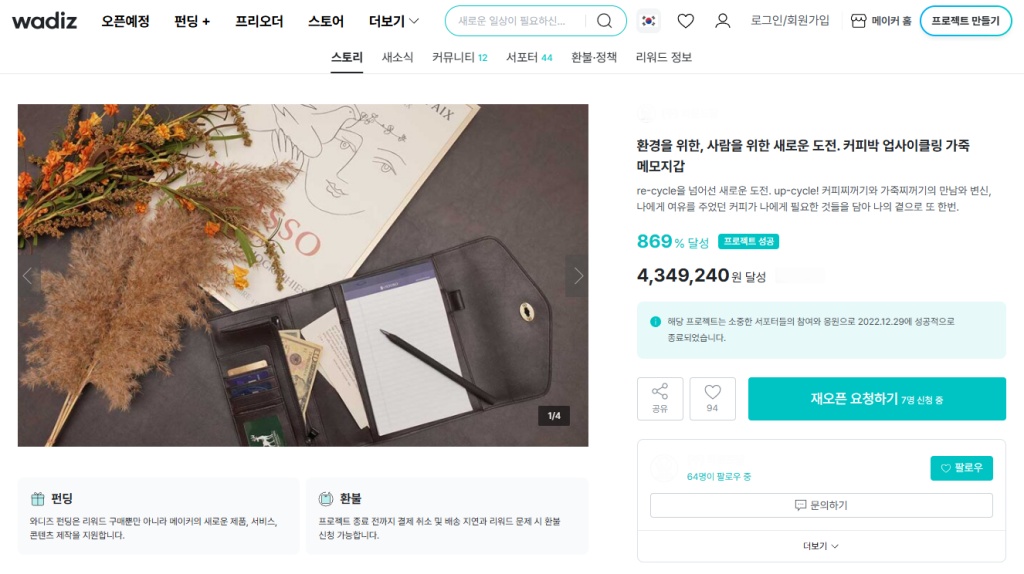
How we set the price
Two criteria guided the diary price: the cost of the material and processes, and the price range of leather diaries already on the market.
Recycled leather has a lower unit cost than genuine leather because of differences in raw material structure. This difference is reflected in the consumer price. The coffee-grounds recycled leather diary was priced somewhat lower than a genuine leather diary of comparable quality. We also designed the difference between the crowdfunding price and the later regular price. Crowdfunding participants are early adopters and also the first people to experience this material. We believed that the way to express gratitude for that choice should be through price.